Consider a point source emitting radiation isotropically in all directions. By placing a spherical shells
If we assume one of the shells, say
which is the inverse square law. Now 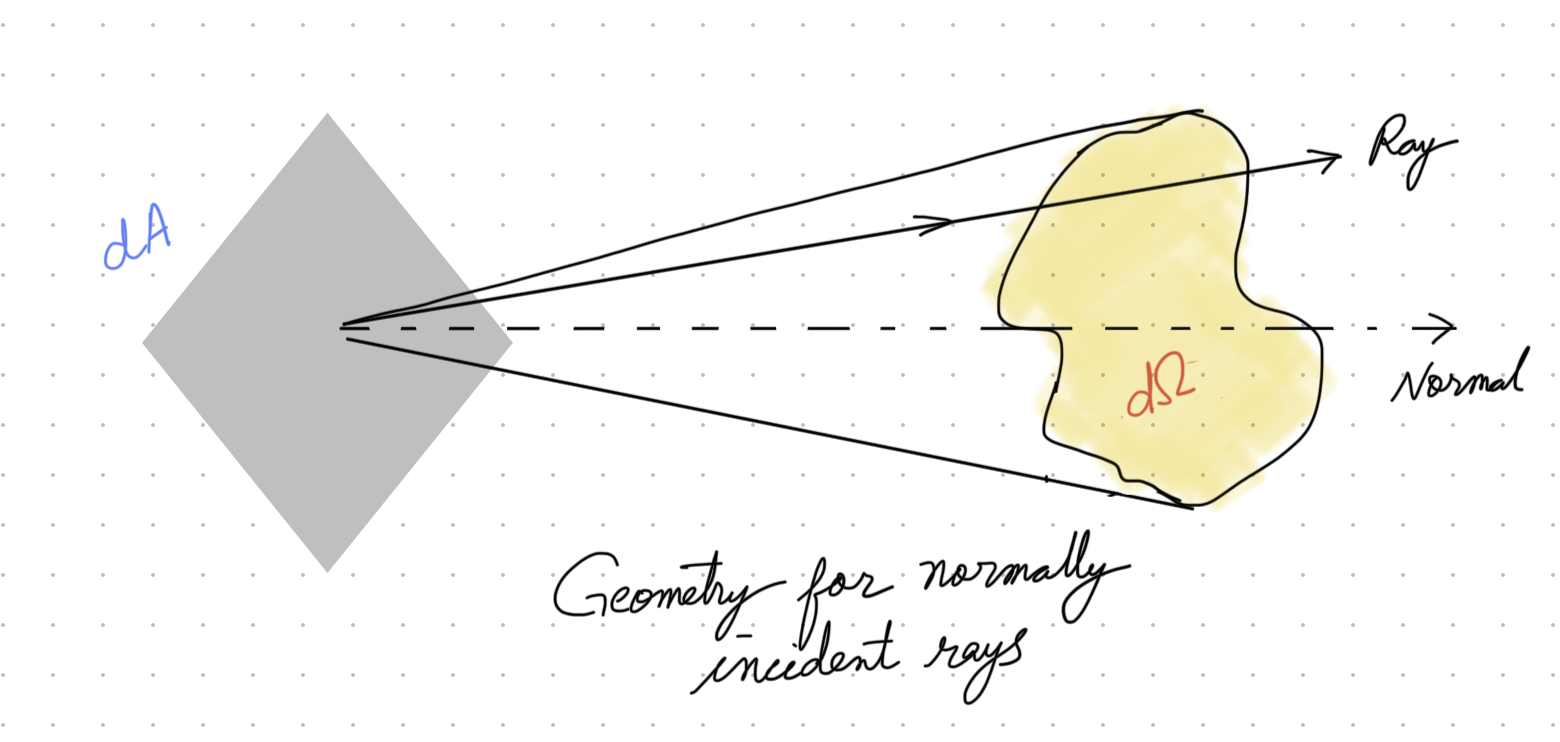 Now this bundle can carry energy as it has some cross-sectional area, which we can write as
We define
- is going to cross the infinitesimally small area
, - towards direction given by
, - in time
, - in the frequency range
.
Because it gives a more detailed description of the radiation field, it is much more instructive to derive other quantities (like flux) from the specific intensity. One way to derive other quantities is to calculate the moments of
Moments of Specific Intensity
Before we derive any moments, let us write equation for
This essentially means all the rays are aligned with
Zeroth moment (Radiation Energy Density)
By definition, zeroth moment of a quantity is something which is does not depend of our independent variable (direction in our case). So we want to derive the quantity which is describes how much radiation is present locally, regardless of the direction. This essentially defines energy density at that location.
To calculate this energy density, we can once again use the isotropic scenario, and imagine a point which is absorbing incoming radiation from all directions. If in time
Now, this energy density is only the contribution from the rays aligned with
A closely associated quantity to
Consequently, we can write:
Finally, we can also calculate total radiation density
First moment (Flux)
Footnotes
-
Note that we are trying to define
as a density function. So although, it does depend on , it is not a density function in . ↩