December 2025
W51·December 21
More problems
Another example of things going wrong. This times, likely some problem in the implementation of planet potential. Also, the movement of the planet in the azimuthal direction also means I am not calculating the planet position correctly to apply its gravity.

W50·December 12
Boundary problems
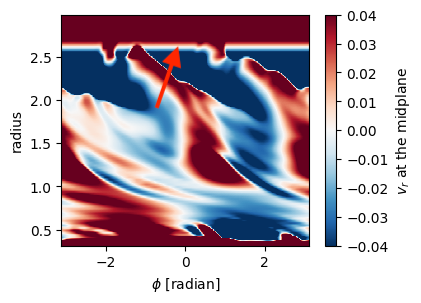
Above is an example of things going wrong. The straight line slightly beyond
The steps to debug and sort out the problem are same as I’m already familiar with. Start with simple and most basic reduced form of the actual problem. Gradually add complexity, one at a time. See how things change.
W50·December 11
Leaky Gaps
Rixin Li has kindly hosted a tutorial on how to run hydro models with Athena++ at his webpage. This includes instructions to run/compile the code, as well as how to setup problem generators and even provides additional scripts to analyze, process and visualize the simulation data in a better way.
W49·December 5
A writeup
The first step is to setup the problem generator file. For our problem, we need to define following interface functions manually:
// This routine does two things: first is to read/parse the accompanying input file
// and then enroll our custom defined source function (which in our case is the
// planet-disk interaction) and BCs.
void Mesh::InitUserMeshData(ParameterInput *pin)

// This will be the core function that will setup the ICs.
void MeshBlock::ProblemGenerator(ParameterInput *pin)
Initial conditions
First step, is to setup the density which is given by:
where
Now, we know,
we can use the temperature profile to find
They chose
which means
And, I think to get the final expression for
Source function
This sets the ICs. Next, we need to set up the planet-disk source function. In the athena++ wiki, this is the place where we can update the conserved variables at each time step, like momentum and energy, but because we are using isothermal EOS, we need to worry only about momentum.
void MySource(MeshBlock *pmb, const Real time, const Real dt,
		const AthenaArray<Real> &prim,
		const AthenaArray<Real> &prim_scalar,
		const AthenaArray<Real> &bcc,
		AthenaArray<Real> &cons,
		AthenaArray<Real> &cons_scalar);
As I understand, for our case, I can just update the momentum by using the momentum density:
where
Boundary conditions
From what I understand, for the radial direction, the authors have adopted symmetric BC, which I think athena++ calls reflective. But instead of reversing sign, they use damping zones, which I think is similar to outflow BC. So I am not sure which one to use. I implemented the damping zones in the source function itself.
For meridional direction, we need to implement a custom BC, as given by equation (9) of the paper:
Now, we can integrate from active cell to ghost cell:
For thin disk approximation,
Note I use the values of active cell as we are integrating from active to ghost cell and
And for the azimuthal direction, I think periodic BC over the whole athena++ wiki page on BCs.
Azimuthal velocity in case of FARGO
In orbital advection runs, that is with FARGO enabled, the
A small note
The exoALMA paper also did not specify what order of orbital advection (FARGO) they used, so not sure which to use.
W49·December 3
Baseline
The work of (Bergez-Casalou et al., 2022) forms one of our baselines. The thing to keep in mind is images of the Solar System’s natal protoplanetary disk. We don’t deal with dust-gas dynamics, just gas dynamics. And instead of looking in the ALMA range of mm/sub-mm, we are going to look in optical/infrared. This is perhaps the right time to introduce Xuntian, or the Chinese space station survey telescope (CSST), the telescope that we will be targeting.
W49·December 2
Small jobs
When testing setups, especially for hydro models, it’s always nice to test with smaller resolution models. They are faster to solve!
W49·December 1
The exoALMA data
The data provided by (Bae et al., 2025) is available on the web. A good starting point was to obviously see if I can at least recreate the plots from the paper, from the paper’s data.
November 2025
W48·November 29
Project start
Setting up Athena++ on my local machine and familiarizing myself with the usual workflow. The official wiki hosted on GitHub is actually the best resource for getting accustomed to the codebase. But of course, for any meaningful simulations, one needs a distributed HPC cluster. Working with HPC means to learn how to submit and run jobs on a system whose resources are shared simultaneously by many. Resources for those:
In the end, each cluster might have their own set of policies. Always refer to the documentation!