Note
This section is based on Section 3.8 of Solar System Dynamics by Murray & Dermott, 2000.
I think it is always good to start with a picture for some things.
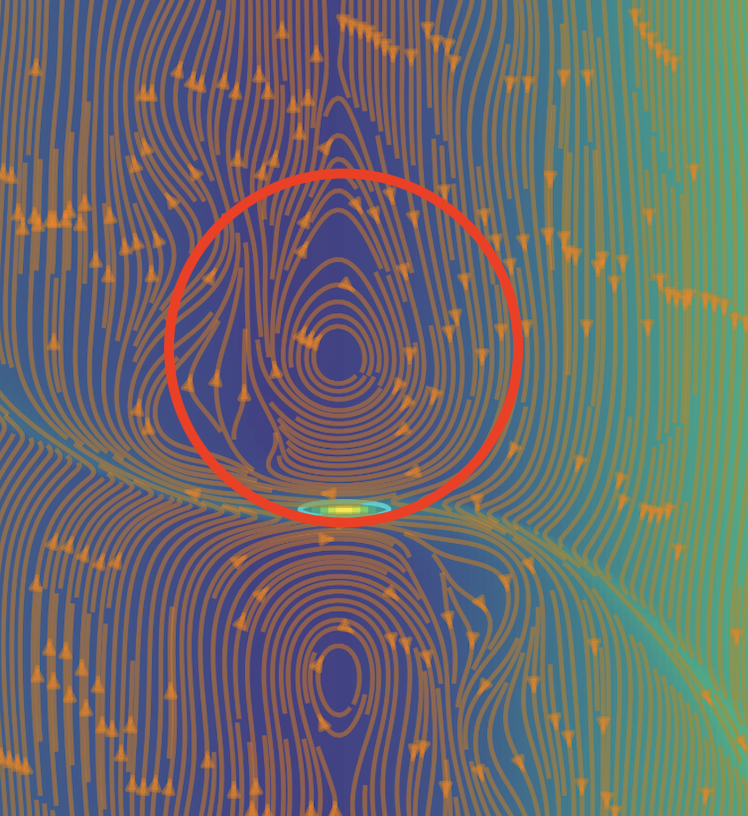 This image presents streamlines around a planetary mass in a viscous gas-only disk. You can see the spiral arms emerging from the planet, both inward and outward, as it rotates around the central mass, perturbing the gas on its either side.
This image was constructed to find if the model had vortex formation, more on that later. I mistakenly assumed that these circles nearby the planet are actually vortices (I was wrong.).
So what do these streamlines represent then? I think the scaling of this figure is a bit deceiving, but these are actually the 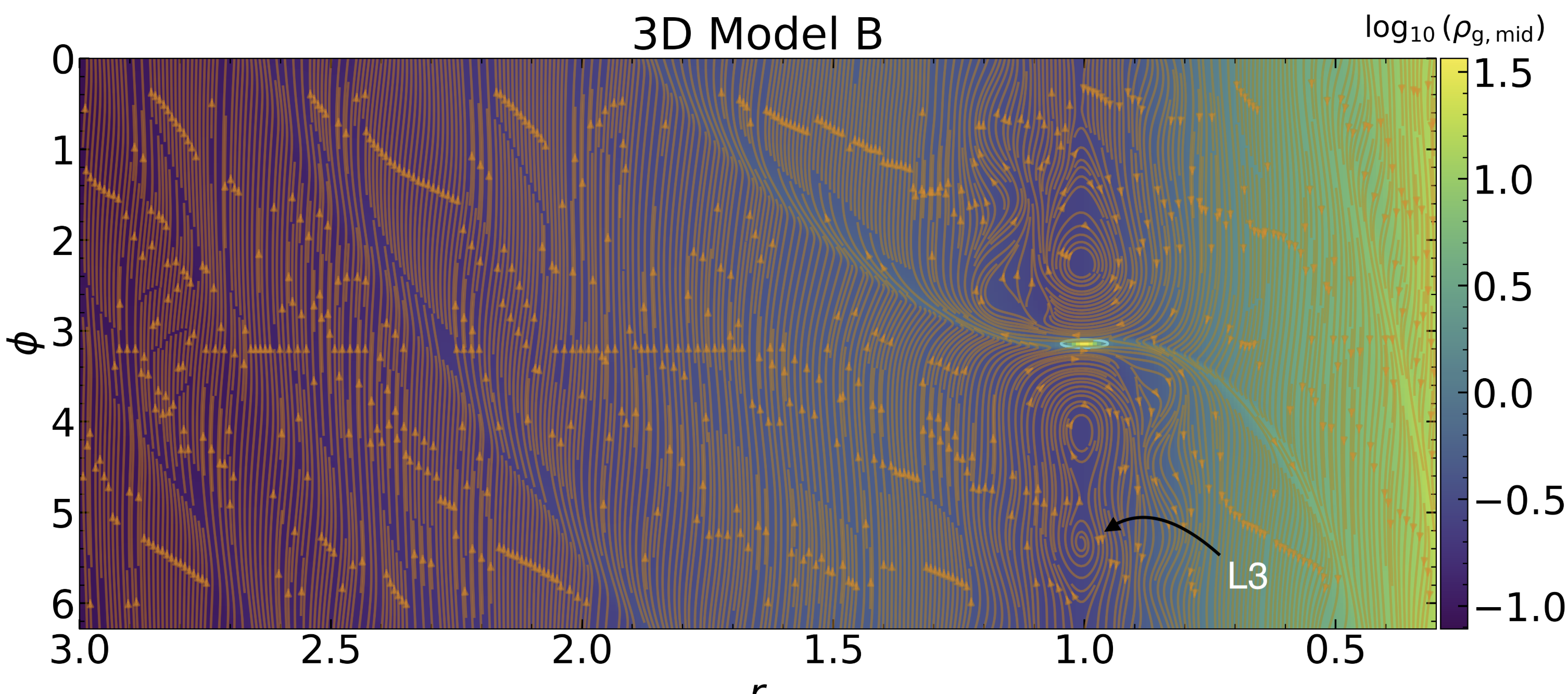
Motion near
If you look at a top-down view of the inner solar system and Jupiter, you will find that is quite a busy place.
